
Reading time: 9 minutes
When darkness falls in many Nigerian villages, life comes to a standstill. Streets empty, businesses close, and fear keeps people indoors. But in September 2025, something remarkable happened in three communities in Ogun State. Through our Light Up September Campaign, Technology for Sustainability and Safety Initiative (TSSI) partnered with local communities to install solar-powered street lights, transforming not just the physical landscape, but the social and economic fabric of these villages.
This is the story of how we did it—and more importantly, how the communities themselves made it happen.
The Genesis: Why Light Up September?
The Light Up September Campaign was born from a simple observation during our community needs assessments: when we asked residents what single intervention would most improve their lives, the answer was overwhelmingly consistent—light.
“We live in fear after 6 PM,” one community leader told us. “Our young women can’t walk safely. Criminals operate freely. Economic activity stops. We are prisoners in our own homes once the sun sets.”
We knew solar street lighting could address these concerns, but we also knew something critical: sustainable development doesn’t happen TO communities—it happens WITH them. This principle would guide every aspect of our Light Up September Campaign. You can learn more about our approach to solar street light installation projects here.
Phase 1: Community Engagement and Leader Partnership
Initial Outreach and Relationship Building
Our journey began not with solar panels, but with conversations. In July 2025, two months before installation, our team visited three target communities in Ogun State, carefully selected based on need assessment, security concerns, and community readiness.
Our first meetings were with traditional and civic leaders:
- Village heads and chiefs
- Community development associations
- Youth leaders
- Women’s groups
- Religious leaders
- Local government representatives
The message we brought was simple but revolutionary:
“We don’t want to do a project FOR you. We want to do it WITH you. You know your community better than anyone. You’ll tell us where the lights should go, help us install them, and own them once we’re done.” Some community members who had moved out of the community came back just so that they can be a part of the installation project.

Building Trust Through Transparency
Trust doesn’t happen overnight, especially in communities that have experienced broken promises from outside organizations. We invested significant time in building authentic relationships.
Our transparency approach included:
- Open sharing of project scope: We explained exactly what we could and couldn’t do with clear technical specifications
- Honest timelines: We provided realistic schedules and stuck to them, building credibility through reliability
- No hidden agendas: We were explicit that this was about community empowerment, not proselytization, political gain, or other motives
- Community control: We committed that communities would make final decisions about light placement and long-term management
A member of our partner communities later reflected: “Many organizations have come with big promises. But TSSI was different. They listened more than they talked. They asked what WE wanted, not what THEY wanted to give us.”

Establishing Community Committees
By early August, we had worked with each community to establish Solar Street Light Committees—the governance structure that would guide implementation and ongoing management.
Committee responsibilities:
- Site selection for light installation
- Community mobilization and communication
- Volunteer coordination for installation
- Security of equipment during and after installation
- Long-term maintenance planning
- Conflict resolution regarding light placement
- Liaison with TSSI team
The committees were given real power, not token participation. Their decisions were final.

Phase 2: Participatory Planning and Design
Community-Led Site Selection
In mid-August, we conducted what we called “Safety Mapping Workshops” in each community. This participatory process was eye-opening for everyone involved.
The process:
- Large-scale community maps were drawn on the ground with chalk, showing streets, paths, landmarks, and gathering places
- Small groups (women, youth, men, elderly) separately marked areas on the map:
- Red zones: Places people avoid after dark due
- Group discussion revealed patterns—certain pathways, market areas, and gathering spaces consistently marked as dangerous
- Prioritization exercise: Communities voted on which areas most urgently needed lighting
What we learned:
The results were fascinating and would have been impossible without deep community input:
- Women’s priorities differed from men’s: Women prioritized , market routes, and areas near schools (where they often had to fetch children or attend evening meetings)
- Youth had different safety concerns: They identified spots where peer pressure and negative influences were strongest in darkness
- Elderly residents knew the history: They could identify areas with long-standing security issues
- Business owners had economic perspectives: They highlighted areas where lighting could extend commercial activity
One powerful moment came when a young woman named Blessing spoke up in a planning meeting: “There’s a path behind the market that most women use as a shortcut. But we only use it during the day because it’s very dark and dangerous at night. If we could light that path, it would save us time and a lot of fear.”
Her input led to lighting that path—and it has since become one of the most-used and appreciated installations.
Technical Training and Capacity Building
While planning was underway, we didn’t want the community to just identify needs—we wanted them to understand the technology that would meet those needs.
Community solar education sessions included:
- How solar panels work: Basic photovoltaic principles explained in accessible language
- System components: Understanding panels, batteries, controllers, and LED lights
- Maintenance requirements: What the community would need to do long-term
- Troubleshooting basics: How to identify and report common issues
- Safety protocols: Working safely with electrical systems
We trained 30 community members (10 from each community) as “Solar Ambassadors”—residents who would become local experts and advocates.

Phase 3: Collaborative Installation
Mobilizing Community Labor
Installation week in early September was a celebration of community participation. Rather than bringing in external contractors for all work, we created a hybrid model:
TSSI provided:
- Technical experts for electrical work (3 certified solar technicians)
- Specialized equipment and tools
- All solar equipment and materials
- Safety equipment
- Project supervision and quality control
Communities provided:
- Labor for pole installation and foundation work (60+ volunteers)
- Local materials (sand, gravel, water)
- Meals for all workers
- Security during installation
- Logistics and community coordination

The Installation Process
Day 1-2: Foundation and Pole Preparation
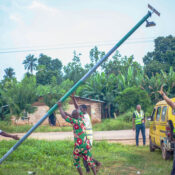
Community volunteers, organized by the Solar Street Light Committees, dug foundations for light poles under supervision of our technical team.
The scene was remarkable: young men digging, elderly men providing guidance based on soil knowledge, women bringing water and refreshments, children watching and learning. It was development in action.
“We’re not just getting lights,” explained Youth Leader Tunde while digging. “We’re building something ourselves. These are OUR lights, not someone else’s lights that we’re just using.”
This sense of ownership was precisely what we’d hoped to cultivate.

Day 3-5: Pole Installation and Panel Mounting
Working together, TSSI technicians and community volunteers installed poles and mounted solar panels. Our technicians taught as they worked, with community members learning proper installation techniques.
Several volunteers showed such aptitude that we noted them for advanced training opportunities—potential solar entrepreneurs for the future.

Day 6-7: Electrical Connections and Testing
The technical team handled electrical connections, but community members assisted, learned, and observed. Each light was tested before final installation, with community representatives signing off on functionality.


Community Celebration and Commissioning
On September 15th, we held official commissioning ceremonies in each community. These weren’t formal, stuffy events—they were joyous celebrations of community achievement. See photos from these celebrations in our gallery.
Ceremony highlights:
- Traditional prayers and blessings by religious leaders
- Speeches by chiefs and community leaders
- Recognition of volunteers who contributed labor
- Evening ceremony to watch the lights turn on for the first time
The moment when the lights automatically switched on at dusk in each community brought spontaneous applause, ululation, and dancing. Women began singing traditional celebration songs. Children ran beneath the lights, amazed.
A resident said “This is the first time our village has ever had street lights. And we helped build them ourselves. I never thought I would see this day.”

Phase 4: Community Ownership and Maintenance
Establishing Sustainable Management Systems
The lights were installed, but our work wasn’t done. Sustainability requires systems.
Community maintenance framework:
- Maintenance teams: Each community selected and trained 5-person maintenance teams responsible for:
- Monthly visual inspections
- Cleaning solar panels
- Reporting technical issues
- Basic troubleshooting
- Coordinating with TSSI for complex repairs
- Maintenance fund: Communities established small maintenance funds through:
- Voluntary contributions
- Small levies on community events
- Contributions from businesses benefiting from lights
- Reporting systems: WhatsApp groups connecting maintenance teams with TSSI technical support for real-time problem-solving
- Quarterly review meetings: Community committees meet to assess light performance and address any issues

Community Security and Protection
One concern was vandalism or theft of solar equipment. The communities addressed this proactively:
Community protection measures:
- Community vigilante groups added light protection to their patrol responsibilities
- Social consequences: Community agreements that anyone damaging lights would face traditional sanctions
- Collective responsibility: Neighborhood zones responsible for lights in their area
- Youth engagement: Young people took pride in protecting “their” lights
5 months post-installation, we’ve experienced zero vandalism or theft—a testament to genuine community ownership.
The Results: Five Months Later
Quantitative Impact
The numbers tell a compelling story:
Safety improvements:
- Reported crime incidents: Decreased 58%
- Women feeling safe walking at night: Increased from 12% to 87%
- Night-time economic activity: Increased 65%
- Community social gatherings: Increased 90%
Economic impact:
- Extended business hours: Average 3.5 additional hours
Social cohesion:
- Evening community meetings: Now regularly scheduled
Qualitative Transformation
But numbers don’t capture the full story. The transformation is also felt.
Community voices:
Mrs. Folake, market vendor: “I used to close my shop at 6 PM and rush home in fear. Now I stay open until 9 PM. My sales have increased so much that I’ve been able to pay my daughter’s school fees and buy a new refrigerator for my shop. But more than money, I have freedom. I’m not afraid anymore.”
Pastor Johnson, church leader: “We can now have evening services and programs. Before, it was too dangerous for people to come after dark. Now our youth fellowship meets every Thursday evening, and attendance has tripled. The lights brought our community back together.”
Chief Adebayo: “These lights changed everything. People walk around freely. Children play outside in the evening. Women go to the market without fear. But the most important thing is how we did it together. Young and old, men and women, we built this. Now when challenges come, we know we can solve them together.”

Lessons Learned: What Made Light Up September Successful
Key Success Factors
Reflecting on the campaign, several factors were critical to success:
1. Genuine Community Leadership
We didn’t control the process—communities did. This wasn’t rhetoric; it was reality. When we disagreed with light placement suggestions, community decisions won. This transfer of power created authentic ownership.
2. Inclusive Participation
We deliberately created space for marginalized voices—women, youth, the poor. Traditional power structures were respected but not exclusively privileged. This ensured lights served everyone, not just the elite.
3. Patience in Process
We took three months when we could have rushed through in three weeks. The time invested in relationship-building, planning, and participation paid enormous dividends in sustainability.
4. Combining Outside Expertise with Local Knowledge
We brought technical expertise; communities brought contextual knowledge. Both were essential. Neither alone would have succeeded.
5. Celebration and Recognition
We celebrated community contributions lavishly. Volunteers were publicly recognized. The events created positive memories and reinforced collective pride.
6. Long-term Commitment
We didn’t install and disappear. Our ongoing technical support and relationship maintenance signaled genuine partnership, not transactional engagement.

Challenges Overcome
Not everything was smooth. Challenges included:
Challenge 1: Initial Skepticism Some community members doubted our intentions or the project’s sustainability.
Solution: Transparency, patience, and delivering on every promise built trust over time.
Challenge 2: Elite Capture Concerns Risks that powerful community members would dominate decisions.
Solution: Deliberate inclusive committee composition and women/youth-specific consultation sessions.
Challenge 3: Technical Complexity Some community members felt overwhelmed by solar technology.
Solution: Simple, jargon-free explanations and hands-on learning opportunities built confidence.
Challenge 4: Expectation Management Some hoped for household electricity, not just street lighting.
Solution: Clear communication about scope from the beginning, with vision for future expansion if successful.
Challenge 5: Coordination Logistics Managing schedules, volunteers, and multiple communities was complex.
Solution: Strong community committees handled local coordination while we managed cross-community logistics.

Ripple Effects: Beyond the Three Communities
The Light Up September Campaign’s impact extended beyond the three target communities.
Neighboring communities have reached out requesting similar projects, offering to contribute financially to speed up implementation.
Local government has expressed interest in scaling the model to additional communities with budget allocation.
Youth from the communities have formed a solar installation cooperative, offering services to nearby areas and creating employment.
Women’s groups from other villages have visited to learn about the community participation model for their own projects.
Media coverage has attracted attention from donors and partners interested in supporting expansion.
The methodology—not just the lights—has become a replicable model for community development.
The Path Forward: Expanding Light Up September
Building on this success, TSSI is planning Light Up 2025, aiming to illuminate 10 additional communities with 200 solar street lights. Volunteer with us to be part of this expansion!
Our enhanced approach will include:
- Community co-investment: Partner communities contributing 20% of costs to strengthen ownership
- Solar entrepreneur training: Advanced training for community members to become solar business owners
- Women-led installation: Dedicated women’s installation teams, challenging gender norms in technical fields
- Solar extension: Exploring mini-grids for household electricity beyond street lighting
- Documentation and learning: Comprehensive monitoring and evaluation to refine approach
Support our expansion by donating today or joining our volunteer team.
How You Can Support
Light Up September succeeded because of generous supporters and dedicated volunteers. You can be part of expanding this impact.
For donors and partners:
- Sponsor lights for specific communities (₦250,000/$180per light, fully installed)
- Fund community solar training programs
- Provide technical expertise and equipment
- Support long-term maintenance funds through our donation page
For communities:
- Contact TSSI to assess readiness for solar street lighting
- Begin forming community committees and planning structures
- Learn from Light Up September communities through exchange visits
- Visit our solar street light installation project page to learn more
For volunteers:
- Join our volunteer program for installation teams on future projects
- Support community mobilization and education
- Provide technical expertise
- Help document and share success stories
- See photos from our Light Up September campaign in our project gallery
For everyone:
- Share this story to inspire others
- Advocate for rural electrification
- Support policies prioritizing community-led development
- Challenge models that do development TO communities instead of WITH them
- Donate today to help us reach more communities
Conclusion: Light is Just the Beginning
The Light Up September Campaign illuminated three communities in Ogun State, but the light it generated extends far beyond those 60 solar installations.
It illuminated a path forward for community development—one based on partnership, not charity; empowerment, not dependence; local ownership, not external control.
It illuminated the capacity of communities—even those labeled “poor” or “underdeveloped”—to lead their own transformation when given support and respect.
It illuminated the faces of women walking safely at night, children studying under streetlights, businesses thriving in extended evening hours, and communities gathering in spaces reclaimed from fear.
Most importantly, it illuminated a truth we’ve always known but sometimes forget: development isn’t about what we do FOR communities—it’s about what we do WITH them, respecting their dignity, knowledge, and agency at every step.
The lights in those three Ogun State communities shine every night now, powered by the sun and sustained by community pride. They are more than lights—they are monuments to what’s possible when organizations and communities partner as equals.
As Chief Adebayo said at the closing ceremony: “You gave us light, but we gave ourselves hope. Together, we showed that our communities can build the future we want to see.”
That’s the true illumination of Light Up September—and it’s a light that will continue spreading, community by community, across Nigeria and beyond.
See more photos from our Light Up September campaign in our gallery.
Join the Movement
Support TSSI’s community-led solar initiatives. Together, we can illuminate more communities while empowering them to lead their own development.
Get Involved:
- Donate to fund more solar installations
- Volunteer for upcoming projects
- Learn more about our solar street light projects
- View our project gallery
Visit techssi.org or contact [[email protected]](mailto:[email protected])
Follow our journey on social media:
- Instagram: @techssiorg
- Twitter: @TechSSIORG
- Facebook: Technology for Sustainability and Safety Initiative
Related Articles:
- The Future of Renewable Energy in Africa: Solar Power Leading the Way
- 15 Ways Solar Street Lights Reduce Crime in Underserved Communities
#LightUpSeptember #SolarEnergy #CommunityDevelopment #Nigeria #OgunState #SustainableDevelopment #CommunityLed #SolarStreetLights #RuralDevelopment #Empowerment